1. Eat Indian food
2. Enjoy driving on paved roads with cars that obey lane divisions
3. Watch TV! I'm not a big TV person so I never thought I'd say this. It'll really be more like watching computer -- we aren't able to stream video here and I need to catch up on The Office, and I could go for some Always Sunny/Curb Your Enthusiasm.
4. Be jaw-droppingly shocked at my multiple drawers and closets of clothes after living in the same 8 shirts, 3 shorts, and 4 pants for the past 4 months
5. Climb a mountain and enjoy the cool air at the summit
6. Cook!
7. Turn off my watch alarm from its three-month-long position at 6:40 am
8. Go for a looonnng run and realize how little the occasional car beeps bother me when compared to hisses, kissing sounds, and other piropos.
9. Watch my 21-year old friends go to bars without me for another month :(
10. Try to remember to put toilet paper in the toilet and not in the wastepaper basket next to it
11. Do laundry with good smelling dry sheets
12. Obtain dark chocolate and rich desserts. No one can do gooey, sugary, artery-clogging sweetness like the United States.
13. Listen to the radio and discover if there really is any music that's emerged since January besides Rebecca Black's "Friday" or parodies of it
14. Probably still wear my field pants a couple times a week
Thursday, April 21, 2011

Wednesday, April 20, 2011
Nitrate-Collecting
Phew. It's been a long week since I last updated.
Our research project got off to a slow start -- although it's nice to have finals first to get studying and memorizing over with, the timing of our project coincides with our two professors (my project mentors) going to a conference at Duke, as well as Semana Santa, when we can't go out to talk to or interview people during the holiday. Also, our nitrate testing kits were sitting at customs until Monday, so it was a whole lot of sitting around, making maps on ArchGIS (by which I mean, watching Steven, our resident bioinformatics major, make maps on ArchGIS).
This was definitely frustrating, and it felt like a lot of factors were out of our control, but THANK GOD, we finally got out to the field on Tuesday and even on our low-budget projects we get to do some SCIENCE, i.e. mixing cadmium to react with any nitrates in the water samples and identify the nitrate level.
Basically, our project is to look at the incidence of gastric cancer in the Coto Brus county, in the Puntarenas of Costa Rica. Costa Rica, as I've mentioned before, has the world's highest gastric cancer incidence, along with Japan. However, because Japan has mandatory endoscopies, they are better able to catch and treat these problems early, leaving Costa Rica with the highest gastric cancer mortality.
We're looking at different areas of Coto Brus and comparing nitrate levels in the drinking water in high gastric cancer areas to those in low gastric cancer areas. The best way we've found to do this is to go up to people's doors and ask them for a water sample. They've all been really happy to give them to us, and it's nice to interact with the locals. So far, we've found....no difference between the areas. But now we're going to explore some coffee farms and test the soil there.
Once we got over the initial frustration of not being able to start data collection, it's been fun! We've pretty much seen nearly every corner of Coto Brus, including winding, red dirt roads with sharp cliffs on either sides, or thin bridges that creak as the safari drives over them. There have been beautiful views of gorgeous green mountains everywhere, but also the constant tests of the safari's abilities and confirmation of my faith in our driver Christian's ability to perform a death-defying three-point turn.
Some of these towns are REALLY out of the way. And for many of them, we would drive, ask for directions, drive some more down hilly dirt roads, and then find a house, or maybe even a pulperia (small store). We'd ask if we were in the right town, and where we could find the center of town. Usually, our response would be, "This is the center!"
On our way home, we were graced with the presence of many beautiful toucans. They were too quick for me to get my camera, but they were gorgeous!
Hasta luego!
Anya
Thursday, April 14, 2011
Last finals until....senior year!
Today at approximately 2:41 PM, Mountain Standard Time, I finished my last final! The causes, control, clinical manifestations, and complications of 36 tropical diseases was a lot to be carrying around in my brain.
Our research project is coming up hard and fast, though. Tomorrow we head to the Area de Salud to check out the incidence reports of gastritis, and then we're spending all day grouping gastritis data by town and EBAIS.
In the meantime, its time to finish the Stieg Larsson triology!
Our research project is coming up hard and fast, though. Tomorrow we head to the Area de Salud to check out the incidence reports of gastritis, and then we're spending all day grouping gastritis data by town and EBAIS.
In the meantime, its time to finish the Stieg Larsson triology!
Sunday, April 10, 2011
Medicinal Plants and Horseback Riding
Today is our last day in Luna Nueva -- we're leaving for San Jose for a night, and then the trek back to Las Cruces on Monday morning. It's our final destination and we're there for a full three weeks; maybe this time I'll actually unpack!
Friday was entirely devoted to our mini-projects. In the course of one day, we collected data on 186 different plants, ran statistical analyses on them, and had an almost-finished paper and a powerpoint presentation ready. My hamstrings are still suffering from the three hours of squatting to measure plant base diameters. The whole thing certainly gave new meaning to the word "deadline," and a new appreciation to semester-long projects.
It was very cool to see a project from the very beginning, when we were first given our assignments, to the end of the day, when we had a whole conclusion drawn out from our findings. Oh, and if you were on the edge of your seats, Quassia amara grows most efficiently in partially obscured light.
While we polished up our presentations and papers on Saturday afternoon, we spent the morning visiting the Maleku indigenous tribe. This is the smallest indigenous group, with only about 600 people. They talked to us about their culture, which -- not to belittle their problems -- was a lot like what we've heard before: the government not really acknowledging their land and slowly pushing them to recede. They do still teach their language in their schools though, and seem to still have a strong connection to their native spirituality.
After browsing their handcrafts, the Maleku man we talked to (I'm terrible at remembering names) took us outside, where we shot some bow and arrows! I doubt that they use these bow and arrows anymore - it was pretty touristy - but it was fun, and with my mediocre accomplishment as the 5th best arrow-shooter I got one of the prizes they had for us, a Maleku balsa mask. I guess those years of archery lessons came in handy.
 On Sunday, we relaxed in typical OTS style: by waking up even earlier! Vanji, Jane, Kayla and I went horseback riding, which was great.
We took a shuttle to a stable near Arenal, and took a trail ride around the volcano. It was beautiful weather, and a very idyllic landscape of green pastures and giant blue mountains all around us. And we even all came back in one piece, despite the lack of helmets provided.

 Tomorrow we're going to Las Cruces to study for final exams and prepare for our final research project.
Hasta luego!
Anya
Friday was entirely devoted to our mini-projects. In the course of one day, we collected data on 186 different plants, ran statistical analyses on them, and had an almost-finished paper and a powerpoint presentation ready. My hamstrings are still suffering from the three hours of squatting to measure plant base diameters. The whole thing certainly gave new meaning to the word "deadline," and a new appreciation to semester-long projects.
It was very cool to see a project from the very beginning, when we were first given our assignments, to the end of the day, when we had a whole conclusion drawn out from our findings. Oh, and if you were on the edge of your seats, Quassia amara grows most efficiently in partially obscured light.
While we polished up our presentations and papers on Saturday afternoon, we spent the morning visiting the Maleku indigenous tribe. This is the smallest indigenous group, with only about 600 people. They talked to us about their culture, which -- not to belittle their problems -- was a lot like what we've heard before: the government not really acknowledging their land and slowly pushing them to recede. They do still teach their language in their schools though, and seem to still have a strong connection to their native spirituality.
After browsing their handcrafts, the Maleku man we talked to (I'm terrible at remembering names) took us outside, where we shot some bow and arrows! I doubt that they use these bow and arrows anymore - it was pretty touristy - but it was fun, and with my mediocre accomplishment as the 5th best arrow-shooter I got one of the prizes they had for us, a Maleku balsa mask. I guess those years of archery lessons came in handy.

We took a shuttle to a stable near Arenal, and took a trail ride around the volcano. It was beautiful weather, and a very idyllic landscape of green pastures and giant blue mountains all around us. And we even all came back in one piece, despite the lack of helmets provided.


Hasta luego!
Anya
Friday, April 8, 2011
Luna Nueva
Goodbye, humid, sticky lowlands. We’re spending the next couple of days in Luna Nueva, a lodge near La Fortuna (toward the northwestern side of Costa Rica). We even passed the volcano Arenal on the bus ride, but even if I had been conscious, it was still too cloudy of a day to distinguish the floating mist from volcano puffs.
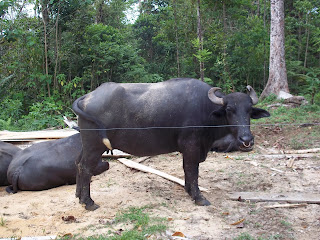
It’s beautiful over here. This place is a vegan’s paradise. Everything is organic, and even the pool at the resort doesn’t use chlorine. It uses ozone, which weirded me out at first (a dangerous air pollutant?) but apparently it oxidizes and removes chemicals and leaves oxygen behind. All of the milk and cheese comes from the cattle nearby, like the water buffalo that we saw hanging out by the medicinal plants garden.

Speaking of the garden, we went on a walk around it for about two and a half hours yesterday. It has a huge variety of plants, from plants with sticky astringent sap that we’ve seen the indigenous people using in Panama to the miracle berry, which makes everything you eat taste sweet. Unfortunately these plants weren’t fruiting (although in Costa Rica, everything tastes sweet as it is!), but we did try the plant used in traditional toothache remedies: chewing the leaves gives your tongue and gums a strong but pleasant numbing, buzzing sensation.
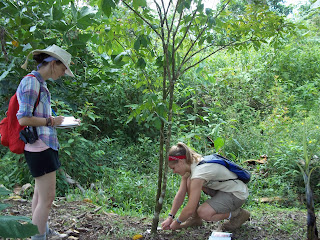
While we’re here, we’re working on a research project. My group is studying a plant, Quassia amara, that has antiulcerogenic properties, and is used for a variety of stomach ailments and even for an antimalarial treatment. Since some of its medicinal compounds have higher concentrations in the sun, we’re studying the growth of the plant in different exposures of sunlight.

Out in the field collecting some Quassia amara
We watched the Michael Moore movie Sicko last night, as we prepare to head back to the country of greedy insurance companies and expensive copays in three weeks. Sensationalist moviemaking and political agendas aside, it’s horrifying and outrageous how securely the insurance companies have their hands around our throats. There’s actually a woman here in Luna Nueva who comes to Costa Rica from the United States to have her hospital appointments!
We're visiting our last indigenous territory, the Maleku, tomorrow. Nostalgia!
Hasta luego,
Anya
Tuesday, April 5, 2011
Pineapple Problems
For the past couple days we've been surviving the heat in an air-conditioned classroom, having a whole lot of class to prepare us for our Luna Nueva trip on Thursday (water buffalo await!).
Since my last post, a bunch of us went on a night hike with Hector and an entomologist researching here. There weren't many mammals (those guys were too busy hanging out on the bridge earlier in the day), but we saw a whole bunch of wandering spiders, glow-in-the-dark scorpions, and a boa constrictor! Apparently ALL scorpions have the rave gene, and can glow in the dark (under a black light).

 A little later on, during the day, we found a blue jeans poison dart frog too!

On Monday we visited an NGO, an environmentally friendly farm that grows fruit, mostly maracuya, or passionfruit. The woman who greeted us showed us a documentary about the huge problem with the pineapple plantation in Costa Rica. We even walked around a section of the pineapple plantation and saw how they egregiously flouted some of the regulations: pineapple can't be planted at a slope greater than 8-12 degrees because its irrigation erodes the land, but some pineapples were planted on slopes of 45 degrees or greater. There is supposed to be a buffer zone of 50 meters of forest around every river, but we saw only about 10 meters of forest around a river that is probably harboring some delicious pesticides.
This was in direct contrast to the banana plantation that we visited last week. Although we saw the cheery touristy side of the banana plantation and we never heard the NGO's side of things, there were still fungicides being sprayed near the worker's area and it was clear that the conditions were less than ideal. That being said, the pineapple plantation wasn't open for people to come poke around like the banana plantation was, and the only reason why we were able to see the blatant disregard for the regulations on the pineapple farm was because it was near a public water source (even more alarming with the heavy pesticide use!) and therefore a section was public property.
The clandestine, sweep-it-under-the-rug nature reminded me a whole lot about the meat industry and the problems with factory farming in the States. Incidentally, Costa Rica doesn't have the same kind of meat industry -- it's mostly local farms -- so the cattle here are more damaged by the bloodsucking flies that come every pineapple season with the burning and harvesting of the fruit. I'm definitely going to be a lot more conscious about where my pineapple is coming from back in the United States.
As a natural sequitor to our pineapple tour, the man showing us around asked some of us if we wanted to ride a horse! When in Rome....

We've been having our last set of lectures -- we finish with our classes tomorrow, as incredible as that is to believe.
Since my last post, a bunch of us went on a night hike with Hector and an entomologist researching here. There weren't many mammals (those guys were too busy hanging out on the bridge earlier in the day), but we saw a whole bunch of wandering spiders, glow-in-the-dark scorpions, and a boa constrictor! Apparently ALL scorpions have the rave gene, and can glow in the dark (under a black light).


On Monday we visited an NGO, an environmentally friendly farm that grows fruit, mostly maracuya, or passionfruit. The woman who greeted us showed us a documentary about the huge problem with the pineapple plantation in Costa Rica. We even walked around a section of the pineapple plantation and saw how they egregiously flouted some of the regulations: pineapple can't be planted at a slope greater than 8-12 degrees because its irrigation erodes the land, but some pineapples were planted on slopes of 45 degrees or greater. There is supposed to be a buffer zone of 50 meters of forest around every river, but we saw only about 10 meters of forest around a river that is probably harboring some delicious pesticides.
This was in direct contrast to the banana plantation that we visited last week. Although we saw the cheery touristy side of the banana plantation and we never heard the NGO's side of things, there were still fungicides being sprayed near the worker's area and it was clear that the conditions were less than ideal. That being said, the pineapple plantation wasn't open for people to come poke around like the banana plantation was, and the only reason why we were able to see the blatant disregard for the regulations on the pineapple farm was because it was near a public water source (even more alarming with the heavy pesticide use!) and therefore a section was public property.
The clandestine, sweep-it-under-the-rug nature reminded me a whole lot about the meat industry and the problems with factory farming in the States. Incidentally, Costa Rica doesn't have the same kind of meat industry -- it's mostly local farms -- so the cattle here are more damaged by the bloodsucking flies that come every pineapple season with the burning and harvesting of the fruit. I'm definitely going to be a lot more conscious about where my pineapple is coming from back in the United States.
As a natural sequitor to our pineapple tour, the man showing us around asked some of us if we wanted to ride a horse! When in Rome....

We've been having our last set of lectures -- we finish with our classes tomorrow, as incredible as that is to believe.
Saturday, April 2, 2011
Plant hunts
The wildlife continues to be amazing here. On the bridge over a gaping river that we cross to get to our classroom, there are usually iguanas as well as SLOTHS. We've seen many two-toed sloths hanging out (I haven't had my camera on me, unfortunately), and even some sloths eating! My friends have even seen a kinkajou
We went on a medicinal plant treasure hunt the other day. To prepare for our fungicides lab, in which we obtain plant extracts to test anti-fungal properties, we needed to collect some specimens. In order to practice our GPS skillz, our ethnobiology professor Hector chose some plants and gave us the GPS points to find them for a geocaching romp in the rainforest.
Sometimes we had to get a little creative to actually get a specimen....
 We've been doing some research on agrotoxicology as well, which applies directly to the plantations that we've been visiting (we've been to a banana plantation, and we're going to the Dole pineapple plantation on Monday).
Somehow along the way, it has inexplicably turned into April. Once this week of lectures and field trips is over, we're going to Luna Nueva, where we'll visit a giant medicinal plant garden, and then visit the Maleku indigenous people. Then it's final exams and research project time!!
Hasta luego,
Anya

We went on a medicinal plant treasure hunt the other day. To prepare for our fungicides lab, in which we obtain plant extracts to test anti-fungal properties, we needed to collect some specimens. In order to practice our GPS skillz, our ethnobiology professor Hector chose some plants and gave us the GPS points to find them for a geocaching romp in the rainforest.
Sometimes we had to get a little creative to actually get a specimen....

Somehow along the way, it has inexplicably turned into April. Once this week of lectures and field trips is over, we're going to Luna Nueva, where we'll visit a giant medicinal plant garden, and then visit the Maleku indigenous people. Then it's final exams and research project time!!
Hasta luego,
Anya
Subscribe to:
Posts (Atom)